America’s youngest jet-setter was seven years old when he boarded a
Pan American World Airways Boeing 707 in New York, headed to Paris. It
was October 26, 1958 and along with his parents and two older sisters,
Loren Hopkins was on an all-expenses-paid, two-week tour of European
capitals. His mother won the trip after entering a contest printed on
the back of a Kellogg’s cereal box.
“She always had a desire to see other places,” said Hopkins, now 68
and a farmer in Kinsman, Ohio, of his mother, Vera. But she’d married a
farmer, and their livelihood did not promise a life of travel. “For my
mother to fly on a jet plane was the adventure of a lifetime,” Hopkins
said.
A U.S. Army band serenaded the flight’s 111 passengers that night
in 1958 as they approached the air stairs leading to the jetliner at
Idlewild Airport. Among them was a genuine celebrity, the actress Greer
Garson, who’d won an Academy Award for her performance in Mrs. Miniver 16 years earlier. (On its return flight from Paris, that 707 would carry Frank Sinatra and Danny Kaye.)
“We walked to the airplane on a red carpet with flags on both
sides,” Hopkins recalled of the rainy night. Floodlights accentuated the
white aluminum airplane’s size: 140 feet long with a 130-foot wingspan.
Its four Pratt & Whitney JT3C-6 turbojet engines were sleek in
polished metal nacelles suspended below and forward of the wings,
rakishly angled 35 degrees off of the fuselage.
An enormous blue globe was painted on the tail of the airplane
named Clipper America just for the flight. This was a new logo designed
specifically for the mid-century modern age the airline was ushering in
with its jetliner, an emblem that promised travelers the world.
And though the 707’s impact on the world was as yet unwritten, Loren Hopkins had an inkling that things were about to change.
“Going on that trip when I was so young made me think, ‘Why not go wherever you want to go?’ ” he said.
Airbus has debuted its much-anticipated A321LR, the world's longest-range jet with a single aisle currently in production.
The plane took its maiden flight Wednesday from the European plane maker's factory in Hamburg, Germany.
'LR' stands for longer range. The plane can fly for 4,000 nautical
miles, or about eight hours of flying, before it needs to refuel.
It is designed for transatlantic routes, as airlines want to fly
non-stop to and from smaller cities that don't have the demand for a big
twin-aisle aircraft.
Airlines like JetBlue Airways said it is
studying whether to buy the A321LR as part of a strategy to potentially
expand its service to Europe. Airbus said Wednesday it has amassed more
than 1,900 orders for the A321neo and its longer-range model from more
than 50 customers.
First
delivery of the jets begin later in 2018 following about 100 hours of
airborne tests over the coming months. The first operator has not yet
been disclosed, but airlines like low-cost carrier Norwegian Air
Shuttle, Air Transat in Canada and Ireland's Aer Lingus have committed
to the plane.
Airbus has made small modifications to its A320neo to create A321LR.It has as many as three additional fuel tanks and can carry about 7,700 pounds of additional gas or passengers and their bags.
The arrival of the A321LR is part of an escalating fight between Airbus and its American rival Boeing (BA) over what the plane makers have dubbed "the middle of the market."
With the A321LR, Airbus says it "has captured a solid 80%" of market
for flights that don't need a long-range jet, but are too busy for a
small single-aisle aircraft.
Boeing, meantime, is still
pondering plans for its first new jetliner since 2011. The jet is dryly
called the "New Mid-Market Airplane," but it has been dubbed the Boeing
"797" by prospective customers.
The "797" is a small twin-aisle
airplane that could seat between 225 and 270 passengers for flights of
up to 5,200 nautical miles, or just over 10 hours.
The jet will
be tailored to serve congested airports on routes such as New York to
Los Angeles. Like the A321LR, the Boeing plane should also be efficient
enough to serve medium-range flights connecting the United States to
smaller European cities.
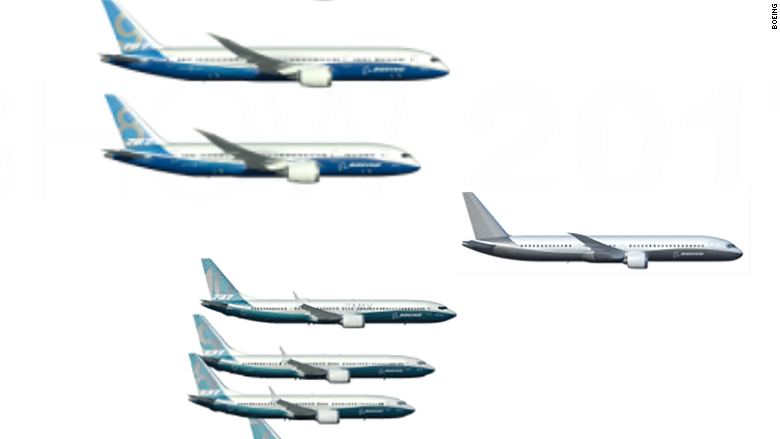
The jet would fill a gap between Boeing's single-aisle 737 workhorse and its advanced long range 787.
A Boeing 797 would fit in between the long-range 787 Dreamliner and its single-aisle 737 Max family.
Boeing hasn't given the green light to build the 797 and would have to
spend $10 billion to $15 billion to bring it so market, a vast sum more
than Airbus is spending to create the lightly upgraded A321LR.
So Boeing will need to charge a premium price to earn back its investment as it battles the A321.
Boeing believes there could be a market for more than 4,000 such
aircraft over 20 years starting around 2025 when the plane would first
flypassengers. However, some industry analysts believe that figure is closer to 2,500 aircraft.
Boeing chief executive Dennis Muilenburg said the company is talking to more than 50 customers about the plane.
Meanwhile, Boeing started taking orders in June
for its stretched 737 Max 10, which arrives in 2020. That's aimed at
blunting the runaway success of the A321neo and sibling A321LR while
Boeing figures out what it wants to do with a new jet.
"We're
not going to launch this airplane unless the business case makes good
sense," Muilenburg said of the prospective 797 on Wednesday. "We still
have time to do our homework and make the right decision, so we're not
going to be rushed into a decision here."
The
cost of operating any aircraft depends on various factors. So
determining the exact cost of operation is not possible. But by making
use of the available data (from 2014), we can estimate the cost.
Fuel Fuel
costs around $1000 per metric ton. An A380 consumes fuel at a rate of
11 metric tonnes per hour. This means that the fuel cost per hour is
$11,000.
Amortization An A380 costs about $350
million. With an amortization period of 20 years, a residual value of
$50 million and an interest rate of 5%, an airline would be paying $24
million per year. That is about $2740 per hour.
Airport charges These
charges vary extremely between airports. Even within an airport, costs
are determined based on the takeoff weight of the aircraft, ground time,
services requested, time of the day (peak hours or non peak hours), and
various other factors. On the lower side, it would cost about $10,500
for a quick turn around and a low takeoff weight. Airport charges could
go up to $25,000.
Overflight charges To cover
ATC costs, countries charge airlines when aircraft fly over their
territory. This cost also varies greatly depending on the region,
distance flown and various other factors. The fee for Europe is about
€1300 per hour. This is $1436 at current conversion rates.
Crew For
a typical airline, the captain is paid $160,000 a year and the first
officer is paid $90,000 a year. This translates to about $350 per hour.
Adding another $80 for allowances, the flight deck crew costs $430 per
hour. Cabin crew rates would be around $40 per hour and for a plane with
a crew of 20, this is $800 per hour. I am ignoring hotel costs and
other allowances for cabin crew . These charges could easily increase
the amount.
Adding all the above costs, it turns out to be around $26,500 per hour on the cheaper side.
Goodbye to the Boeing 747, the Plane That Changed the World The first wide-body jet opened air travel to the masses, created the era of first class vs. coach, and shrank the globe. Why the future belongs to smaller planes.
As epoch-ending statements go, this one was stealthy and carefully modulated: “It is reasonably possible that we could decide to end production of the 747.”
And so it slipped out, in a filing to the Securities and Exchange Commission, first reported by Aviation Week, that Boeing foresees the moment when the single most consequential airplane it ever built will come to the end of its viable life—probably around 2020, which would give the 747 fifty years in production.
Like millions of people across the globe, I long ago came to take the 747—the Jumbo Jet—waiting at an airport gate as a distinctive and welcome presence, an airplane that reassured you with its substance and solidity; never exactly sexy but with a personality that other airplanes never quite reached, something above being just an exquisite machine.
In truth, though, for me the attachment is stronger and more personal. Some 23 years ago I published a book about the 747, which turned out to be a story about much more than a machine. It was about a singular group of engineers who brought the machine to life in a way that permanently marked their own life experience, always under stress, often tested to the limits of their skills but never, never daunted.
I realized that I wasn’t just writing about a machine, but the biography of a machine and its creators, a process in which you get to know the subject so intimately that you can’t ever shake off the effect of the achievement. As a result of writing the book, every time I board a 747 it remains impossible not to think about its details, visible and invisible, without hearing the voices of those whose work it was, the scores of engineers I had interviewed, most of them at that point living out their retirement in and around Seattle.
And of all those stories there is one that shows how daringly improvised the creation of the 747 sometimes was—in a real sense it describes the genesis of the whole concept.
Milt Heinemann was not a salesman at Boeing but there was a single quite scary moment in his career when he sold the biggest idea ever to come out of the company.
It happened one morning in 1966. Heinemann had a meeting with the top managers of Pan Am in the airline’s eponymous building that rose above Grand Central station in New York.
Deliberately, he arrived a little early, and was shown into the boardroom on the 52nd floor. From his briefcase he pulled out a length of hemp rope, 35 feet long. It was knotted at two points, at 20 feet and 29 feet.
He played out the rope across the width of the boardroom, and it turned out to be just a tad wider than the 20 feet marker. Then he pulled out a chair from beside the boardroom table, stood on it, and with the 20 feet knot on the floor stretched up to the ceiling. The ceiling height was just beyond the 29 feet knot.
Nobody had witnessed this strange behavior. Had they done so they might well have decided that Heinemann was nuts. He wound up the rope and put it back in his briefcase, pulled out a wad of documents and sat down at the table.
A little later the managers filed in, led by Pan Am’s imperious creator and chairman, Juan Trippe. The business of the day was to hear out Heinemann on Boeing’s latest plans for a new airplane, the 747.
Trippe wanted an airliner that was at least twice the size of the first Boeing passenger jet, the 707. Until that moment he believed that the 747 would simply be a 707 with two decks instead of one and otherwise follow conventional dimensions in each cabin.
Heinemann had been sent from Seattle to tell Trippe that Boeing had a radical new concept for the 747. It would have only one deck for passengers—a very wide deck. Heinemann explained that, essentially, the cabin would virtually have the internal dimensions of the Pan Am boardroom: 19 feet wide and nine feet high. They were, he said, to all intents and purposes now sitting in that cabin.
There was a silence while Trippe’s obedient managers awaited his response and Heinemann wished he could disappear. Finally Trippe said only that it was an interesting proposal and he wanted to know more —a lot more. It wasn’t the airplane he thought he was buying.
In the history of companies
handing off the delivery of potentially deal-breaking news to a
relatively junior executive this one deserves a prime slot. Heinemann
was a modestly ranked engineer at Boeing. His specialty was cabin
interiors and in the Boeing hierarchy the engineers who designed the
frame of a new airplane and its working parts—thousands of working
parts—came first in responsibility and influence. To them, the cabin was
décor.
When Boeing made a pitch
for a new airplane to an airline, Heinemann was always the last to
speak. He liked to say that he was responsible for the only part of the
airplane that made a profit: the seats.
And
yet what Heinemann had described to Trippe that day was momentous. For
the first time an airplane cabin could break free from the confinement
of a tube, the conventional form with a single-aisle and six-abreast
seating.
There were many
other innovations in the 747 but what became known as the twin-aisle
wide-body cabin was the most far-reaching. However, even though Trippe
accepted the concept and Pan Am was the first airline to fly the 747 he
never thought it would endure. His plan was for the wide-body, this
capacious but bulbous machine, to be replaced by a supersonic jet, the
SST, flying two and half times as fast, with a slender fuselage shaped
for speed.
The 747,
Trippe believed, was just a useful stopgap and once the SST arrived it
would revert to carrying cargo only—the reason why it had been designed
with a cockpit in the hump above the main deck was so that cargo could
be loaded through a hinged door at the nose.
That never happened. The
U.S. government-sponsored SST program was abandoned. Its economics were
awful and the environmental impact equally egregious—only one SST, the
Anglo-French Concorde, gained an established place on airline routes and
then only as an elitist convenience.
Ironically, Trippe didn’t
seem to appreciate that the 747 would enable aviation to initiate the
age of widely affordable air travel. In the first phase of the Jet Age,
beginning in the late 1950s, the passengers frequently looked as sexy
and glamorous as the machines, but flying remained well beyond the means
of the middle class.
With
the 747, Trippe had set Boeing the goal of achieving what would be a
new price point for airline travel. The economics of an airplane are
expressed in the seat/mile cost—given a nominal number of seats, the
cost of flying one seat one mile. Trippe wanted that number to be 6.6
cents per mile, one third of the 707’s cost.
By reaching that number, in
one leap the 747 not only put flying within the reach of many more
people, it did so on a global basis. In airports around the world the
747 became a mesmerizing and inimitable presence. Small countries where
leaders had big egos and autocratic style bought 747s as prestige
projects.
In that way
the 747 went beyond being just an airplane to being a ubiquitous
advertisement of America’s attainments. More substantially, it was an
instrument of social advancement, introducing a new math that enabled
coach class seats to be sold at prices that brought international travel
to many millions more people.
The result, however, was often far from egalitarian.
Because
the 747’s size allowed a variety of cabin comfort standards, airlines
began to see that they could make an airplane a microcosm of an
increasingly affluent but still stratified society. For one thing, what
could be a more specifically delineated society than the three-class
cabin?
Without altering
the basic utility of the machine—everybody departs and arrives at the
same time—the passengers are divided by carefully calculated levels of
comfort.
At the front end there was
first class, replicating what in the early post-war years of
international flights had been common throughout the cabin, well-spaced
wide seats and restaurant-style meal service. In the middle came
business class at first, relatively few seats). And then in the rear,
with 10 seats in each row and tight space between each row, there was
coach—or cattle class, as it was frequently described by those who liked
the price but not the discomfort.
This stratification of the
wide-body cabin has now become such a finely tuned work of airline
business plans that there are now regularly four classes, not three,
with the arrival of "premium economy" - something of a contradiction in
terms in both concept and execution, but fine for those who want to
escape the press of bodies in the back of the airplane but who don’t
want to pay a whole lot more to do so.
In
this new world, the art of successfully filling seats of four different
sizes on every flight has actually ended up dictating the size and
shape of every new wide-body plane, whether built by Boeing or Airbus.
And it is this calculation that, in the end, has been the nemesis of the
747.
As the economics
of the wide-body cabin were refined it became apparent that a
four-engined airplane like the 747 was less competitive than one with
two engines—and so in the 1990s Boeing created the first “big twin” the
777.
The latest and final
iteration of the 747, the 747-8, launched in 2010, has new and more
efficient wings and a new generation of engines that are more efficient,
cleaner and quieter. But orders for the 747-8 have slumped, with a
backlog now of only 21 airplanes. The production rate has been cut to
the lowest sustainable level: 0.5 per month.
Without
admitting as much, it is Boeing itself that has rendered the 747-8
obsolescent by launching a new generation of the 777, the 777X, planned
to arrive in 2020. It will be capable of flying as many passengers as
the original 747, more than 400, at a lower cost than the 747-8.
Already, airlines have ordered more than 300.
It
may well be that the only other supersized jet, the Airbus A380, will
be the last of the big jets. Launched with high expectations in 2000,
only 319 A380s have been sold, and 142 were bought by one airline,
Emirates. Other airlines have canceled orders and, like Boeing, Airbus
is undermining the logic of its jumbo with a big twin, the A350, that on
many long-haul routes is more efficient.
Perhaps
this is another tough lesson that the future does not always turn out
as imagined, a series of big technical advances bringing startling
transformations. Commercial jets fly no faster today than the Boeing 707
that arrived in 1957. That was a quantum leap but it had its own
terminating speed wall, 600 mph. Supersonic flight just doesn’t make
economic sense for mass air travel.
It
seems equally likely that mega-sized jets will turn out to be a dead
end. A combination of market forces and tough new environmental
regulations, stressing efficiency, quietness, and low emissions favors
the twins.
In no way
does that diminish the glory of the 747. By the end of its run Boeing
will have produced 1,555 747s, way beyond what its creators imagined
possible. But it’s not just about numbers. I’ve been flying on 747s
since the year of its debut, 1970. As I take my seat and look around me
it still seems so big that it’s amazing it can leave the ground. It is a
magic machine that casts its own spell and that won’t be quickly
snuffed out.
Jumbo, The Making of the Boeing 747, by Clive Irving is available on Kindle from Amazon and also in paperback.
IT’S
1943 — IN THE THICK OF WORLD WAR II — AND A NEW GERMAN JET FIGHTER IS
MENACING THE SKIES OVER EUROPE. AMID MOUNTING FEARS, ARMY BRASS TURNS TO
MICHIGAN ENGINEERING ALUMNUS CLARENCE “KELLY” JOHNSON TO THWART THE
NAZI THREAT.
The Nazi regime
had been trying to develop a jet aircraft since well before the onset of
World War II, and in mid-1943 it introduced the world’s first
operational jet-powered fighter — the Messerschmitt Me-262 Schwalbe
(“Swallow”). German officers viewed its most effective use as a fighter
against Allied bombers, but Adolf Hitler — infatuated with the Me-262’s
superior speed — liked its potential as a high-speed, light-payload
Schnellbomber (“fast bomber”). And as this brief Nazi debate took place,
the Allies still were flying nothing but propeller planes.
n
June 17, 1943, Clarence “Kelly” Johnson, Lockheed’s 33-year-old chief
engineer, was at the U.S. Air Corp’s Eglin Field in Florida, observing
the performance of the latest version of his P-38 Lightning war plane.
This
was the day Johnson (BSE AeroE ’32, MSE ’33) first learned — as Wright
Field’s Colonel M.S. Roth sidled over to confide in a whisper — that the
U.S. military was testing a new U.S. Bell jet.
“You wanted to build a jet for us once,” Roth reminded Johnson. But Johnson didn’t need any reminders.
Johnson
and Lockheed had developed the P-38 beginning in 1937. And though it
still was the nation’s fastest propeller-driven fighter, Johnson had
only been able to increase its speed by a mere 17 miles per hour — even
while nearly doubling its power. In 1939, with the Brits and the Germans
working feverishly on jet turbines, Johnson proposed his own audacious
new jet design that he claimed would approach the speed of sound. But
the Air Corps — more eager for more planes to fly more immediately into
battle — turned him down flat.
England’s
Frank Whittle had since made significant progress on a jet
engine — with Germany’s Ernst Heinkel remaining consistently ahead of
his pace. But the U.S. military had only timidly experimented with a
Bell P-59 jet, which proved ineffectual.
Now,
a very worried U.S. Army Air Force was obsessed with the Messerschmitt
Me-262 — Germany’s latest, superior jet fighter — and the very real
prospect that the enemy German Luftwaffe would soon be dominating the
skies over Europe. The Me-262 was much faster and better armed than any
plane in the Allied arsenal. It was striking terror in every military
officer with awareness not just of its current capabilities, but of its
fearsome potential wrath — and consuming their every waking thought. What the Hell was that?
Worse,
a reluctant Roth confessed to Johnson, this new U.S. Bell jet’s
performance had been deeply disappointing. Like the old, tentative Bell
jet introduced several years earlier, this new one was flying barely
faster than Johnson’s propeller-driven Lightning.
And now Roth — finally! — was asking Johnson if he would be willing to try again.
Roth
told Johnson the top-secret jet plane would need to fly more than 100
mph faster than the Lightning. It would need to fly more than 500 mph to
combat the Nazi fighter.
“Just give me the specs,” Johnson growled.
Johnson
had scribbled nonstop on the backs of envelopes and in the margins of
magazines on the flight back to Burbank from Florida. As soon as he
stepped off the plane at Lockheed’s Air Terminal, Johnson bolted up the
stairs to Lockheed President Robert Gross’ office, where Gross and
Johnson’s boss, Hall Hibbard, were waiting.
It
was a hot day in June, and Johnson was about to be grilled by his
Burbank bosses about his Eglin Field encounter with Col. Roth the day
before. But the robust Johnson’s demeanor remained forceful, his
expression self-confident, his black hair slicked and neatly combed.
Once inside the inner sanctum, Johnson launched right in.
“The
Army Air Force wants us to submit a proposal for building a plane
around a jet engine. I’ve worked out some figures. They want it fast,
and I think I can promise 180-day delivery. What do you think?”
“180 days!” Gross stammered.
That
schedule seemed nothing more than a fantasy. No company ever had
designed and built any kind of prototype in anywhere near that kind of
time — let alone a prototype for a jet fighter. But this was different.
This was a top-secret assignment to develop a critical weapon to beat
back the Nazi threat. This would be the most important challenge in
American aviation.
A
brief round of hand-wringing and head-shaking followed. But if either
Gross or Hibbard thought of saying “no,” neither said the word
aloud — and Johnson went straightaway to a drawing board to resume his
calculations.
Within
the week, Johnson had packed up numerous sketches and dozens of pages
of detailed specifications and hand-delivered them to Gen. Frank Carrol,
commanding officer of Wright Field.
“We’ll give you the contract,” Carrol told Johnson.
Johnson
had promised Roth a prototype in 180 days — and the high command was
just desperate enough to believe him. “You better get moving,” Carrol
told Johnson. “This is Day Number One.”
And before the day was out, Johnson was back on a plane to Burbank, letter of intent in hand.
“DAMMIT..DO IT.”
“It’s your baby,” Gross told Johnson, now back at Lockheed. But Gross remained skeptical about the ridiculous time demands.
“I
don’t think anything will come of it, but you’ve brought this on
yourself,” Gross said. “We’ll give you all the help we can, but you’ve
got to rake up your own engineering department and your own production
people and figure out where to put this project. Now go set up shop.”
Lockheed
already was building 28 military planes a day. There were no spare
engineers, and no spare machinery or space. But Gross’ admonition
sounded like a dream finally realized for Johnson, who had long pestered
Gross and Hibbard for an experimental shop in which a small group of
talented design engineers, mechanics, and manufacturers could work
together without complication or delay.
The
Army promised its full cooperation, and six days after Johnson left
Wright Field, all the equipment it was obligated to provide — guns,
radios, tires, wheels, air-speed indicators, and other instruments — had
arrived at Lockheed’s Burbank plant, ready to be installed as the
design and construction schedule rolled out. To ensure the availability
of all other tools that couldn’t be spared from its ongoing production
line, Lockheed bought out an entire local machine shop.
Johnson’s
willful personality and reputation played no small part in the wide
berth granted Johnson by the Lockheed and Air Corps brass. With so much
at stake, responsibility and authority would need to be concentrated in
just one man — and only one man was qualified. As much a salesman as a
designer and engineer, Johnson was an energetic promoter who knew how to
dominate meetings, even among military personnel well accustomed to
having their way.
To
the extent possible, this experimental shop would need to behave as a
single person. And to fully exploit his autonomy, Johnson sought to set
up far away from the office and shops, in an open area adjacent to the
plant’s wind tunnel — which offered three distinct advantages. It was at
the extreme end of the complex, where few others operated. Its
proximity to the wind tunnel would prove useful and convenient for
testing, as needed. And on the far side of this remote area sat a
noxious plastics factory, whose stench would keep the curious at
bay — and soon the group would be nicknamed “Skunk Works.”
Johnson
had plant engineering clear the space beside the wind tunnel, and
within 10 days they had slapped together a drafty and unheated temporary
structure covering 11,000 square feet. Ordinary construction materials
were scarce in wartime, so the crew cobbled its walls with huge old
Wright engine crates left over from deliveries for the Hudson bomber,
assorted scrap lumber and canvas. And for the roof, Johnson rented a
giant circus tent.
Now
Johnson put on his overalls and brazenly walked around the factory,
“stealing” — as he put it — the company’s top people. People who would
be willing to work under the motto Johnson had embossed on his notebook
covers:
“Dammit..Do It.”
YOUNG KELLY JOHNSON
Clarence
Leonard Johnson — nicknamed “Kelly” as a grade-schooler — was smart,
hard working and intensely ambitious. As a scholarship student at
Michigan Engineering (BSE AeroE ’32, MSE ’33), Professor Edward Stalker
hired him as his wind tunnel assistant, and when Johnson disagreed with
his professor’s assessment that Lockheed’s new twin-engine Electra was
stable, he was immediately overruled. But the brash Johnson didn’t
hesitate to reiterate his concerns to Lockheed, which had hired him soon
after he graduated.
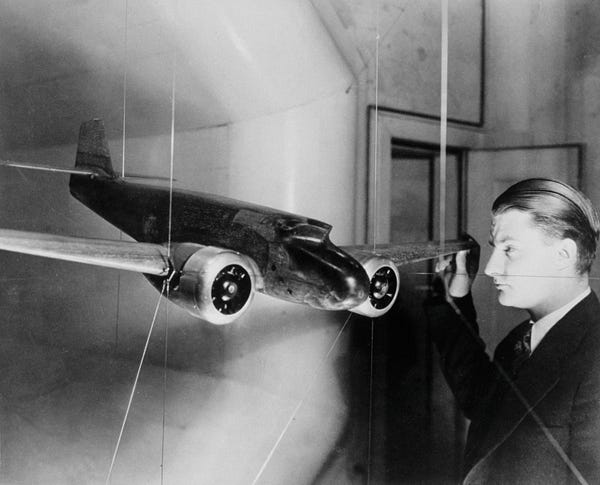
His
Lockheed superiors suppressed their first thought — which was to fire
him — and instead sent Johnson back to the Michigan wind tunnel with the
big Electra model crammed into the back seat of his car. Subsequent
tests and modifications — including the unconventional twin-tail design
that would become his signature — not only vindicated Johnson, but
returned him to Burbank a hero.
“OUR DAYS ARE NUMBERED”
Johnson
knew a formal contract between the parties would not be forthcoming for
months — but the signed letter of intent dated June 22, 1943,
nonetheless obligated the just-formed Skunk Works to deliver the
prototype airframe before Christmas.
The
design of the prototype — officially the XP-80 but affectionately
called the Lulu Belle (and later the Shooting Star) — was uncomplicated
enough, theoretically, to construct within this sped-up timeframe. But
to keep every man firmly focused on the unrelenting passage of days,
Johnson installed a big scoreboard countdown calendar — a large red sign
attached to the back wall entitled, “Our Days Are Numbered.”
Every
morning, the preceding day would be pulled off — and the new day
recognized. Work seemed to have just begun, but there it was: “This is
Day No. 14: 166 to go.”
The
clock was ticking. But rather than hearing the sound it made, the
crew’s 23 engineers and its ever-expanding staff of shop mechanics
actually watched each day torn from its moorings. Johnson hated to have
to do this. Coming to grips with another day coming and going was
difficult for everyone. But time pressures were intense — and Johnson
wanted his men to know it.
On
Day No. 19, the crew finalized a wooden mock-up of the airplane — the
project’s first substantial completion milestone — right on schedule.
Johnson wanted to make the mockup unusually detailed to discourage
changes, and when Air Force personnel arrived from Washington for the
inspection, no changes were made.
Later
it was discovered that the occasional walks mechanics needed to take
along the wings’ surfaces were causing slight displacements that still
were significant enough to throw the plane out of trim. The crew worked
on various fixes, but Johnson ultimately implemented a modification that
improved the craft’s stall characteristics — which also made the plane
less sensitive to minor wing contour changes.
As
the mission neared its halfway mark, the men struggled to develop an
optimally aerodynamic fuselage that would also readily accommodate
engine and armament installation and repair. Finally they devised a
workable wing section redesign, and the moment draftsmen finalized
updated blueprints, mechanics were building the sections. The redesigned
wings were completed — and ready for mating to the fuselage — on Day
No. 83.
Which — according to Johnson’s master schedule — was just in time.
In the background: The only existing photo of the original Skunk Works tent.
In
September 1943, the Luftwaffe introduced a jet-powered bomber — the
Arado Ar 234, with an estimated maximum speed of 480 mph and a range of
1,240 miles. But this was still a prototype — the Nazis had not yet made
the aircraft fully operational — and during a prototype test flight on
October 2, 1943, it dived into the ground from nearly 4,000 feet and
crashed at Rheine, near Münster. Both of the plane’s engines had failed,
a wing had caught fire — and its pilot died instantly upon impact.
NOW HOW ABOUT THAT ENGINE?
When
Johnson had his meeting with Gen. Carrol at Wright Field, Carrol had
not only approved a contract for the prototype but for a new
Lockheed-designed jet engine as well.
“But
you’ll have to use the new engine the British have promised us in the
first airplane,” Carrol told him. “We’ll need it — and all the jet
fighters you can build — as soon as possible to use against the Me-262.
Your new engine couldn’t possibly be ready for service in time.”
The British engine in question was not the Whittle-designed turbine used in the failed Bell jet, but a new de Havilland design.
“What’s it look like?” Kelly had asked Carrol.
“Sorry, Kelly. It’s top secret. We can’t tell you.”
Johnson
and Lockheed had accepted these terms, of course, but the most
difficult aspect of the mission had always been working without an
engine. The engineers knew only that they were building an urgent
prototype, and only five knew it was for a jet plane. The Air Corps gave
Johnson some drawings and specifications, but most knew absolutely
nothing about the engine. And not one person — not even Johnson — had
ever seen it.
The Army Transport Command had promised to fly the engine from London to Burbank, but still there was no sign of it.
And
to make matters worse, the sickness rate among the men was climbing.
Johnson believed in working smart — and working longer than was healthy
or productive in a cold and drafty building was just plain stupid. From
Day No. 1, Johnson had based his production schedule on a 10-hour
day/six-day week, with work on Sunday strictly forbidden. Now, as the
days on the scoreboard dwindled, a 25 to 30 percent absentee rate was
reaching 50 percent or more.
“By
coming back in here on Sunday, you are hurting the project,” Johnson
said, doubling down on his insistence that the rule be obeyed. “You
don’t get enough rest and you get sick. The next man I catch in here on
Sunday goes back to the B-17s.”
The
crew ran and re-ran safety tests, anticipating the engine’s arrival.
The days passed, one after another, and the mornings and evenings grew
chill. More anxious than ever to test the plane’s engine before its
crucial aerial debut, Johnson and his top aides were starting to fret.
When
the transport finally arrived — on November 3, 1943; Day No. 132 — it
carried not just the engine but a British civilian expert technician.
Exhausted from the long flight, the Englishman asked if he could go to
his hotel in Hollywood for a brief rest before tests would begin.
Several
hours passed and the Brit still hadn’t returned. Johnson called the
hotel, and was told the technician had never checked in. Following an
unsuccessful manhunt through Hollywood, Johnson checked the
missing-persons bureau, where he found his expert in custody.
The
man had unsuspectingly jaywalked across Hollywood Boulevard,
apparently, and had no draft card or passport or any other form of
identification — so the police had no choice but to arrest him. He
referred the police to Lockheed, where of course no one knew anything
about any British technician or top-secret plane. By that time,
Johnson’s expert was in so deep with the law that his release couldn’t
be secured — even with the help of the U.S. War Department — until the
following morning.
That
morning the plane was suspended by belly bands for flutter and
vibration tests. Fuel was pumped in and out, and brake tests conducted.
The cockpit canopy release mechanism test shook the makeshift tent so
forcefully that those present thought the entire structure was about to
collapse. And when the crew readied to pull the Lulu Belle out for her
maiden voyage, they discovered that because of the way the tent had been
hurriedly assembled, the whole thing had to be torn down so the plane
could exit.
Finally
— on Day No. 139 — the Lulu Belle was secretly trucked out in the dead
of night to the California Muroc Restricted Air Base (now Edwards Air
Force Base) to run the engine. And the first time the starter button was
pressed, the British-designed de Havilland engine roared spectacularly
to life.
Notwithstanding
previous delays, Johnson now felt more confident than ever that his
Skunk Works crew would deliver on time. And just four days later, on
November 15, 1943 — Day No.143 — the Army Air Force officially approved
and accepted delivery of the promised jet fighter prototype — a full 37
days ahead of the Army’s schedule.
Johnson
was especially gratified because his private schedule had always been
150 days. But now the Lulu Belle would need to become the Shooting
Star — a pilot-safe, fully operational jet fighter.
Later
that evening — during the plane’s final tune-up, with the powerful
engine howling at full power — a tremendous bang was heard. Johnson,
standing between the two engine ducts to watch the operation closely,
almost lost his pants down the intake. Both ducts had collapsed, and
before the engine could be turned off, pieces of flying metal were
vanishing — with a violent and angry cry — into the engine’s hungry
mouth.
Jet
engines aren’t designed to digest metal, but perhaps the damage wasn’t
too serious — that was the prevailing hope as Johnson and several others
violated the Sunday rule, tearing into the engine’s British nuts and
bolts with unfamiliar British tools. Disassembly was completed just
before dawn, and the Brit peered into the grease-smeared faces of the
mechanics, who awaited the expert’s word.
“This
crack in the compressor housing — you’d better ask for another engine,”
he frowned. “I’m frightfully sorry, but you won’t be able to fly this
one.”
This
information — and the crew’s disappointment — sunk in all at once. The
intake ducts would have to be redesigned and newly fabricated. And
Skunks Works could do nothing but wait until another English engine was
delivered.
ORIGINAL SKONK WORKS
When
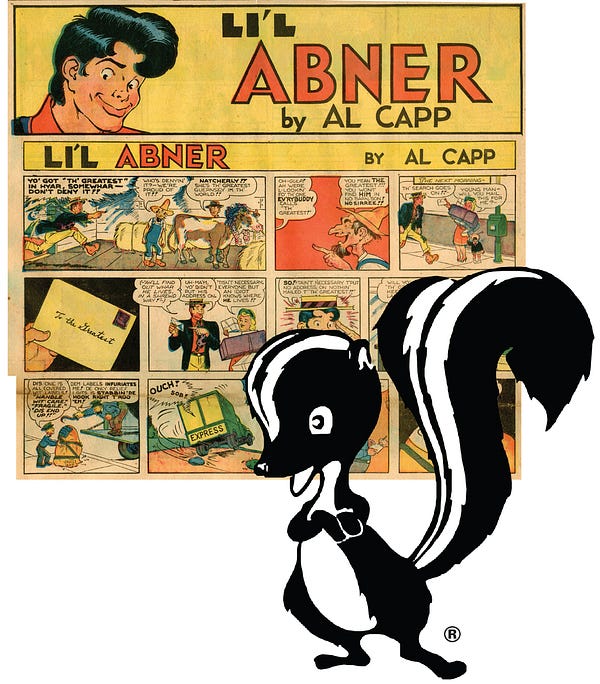
Johnson was setting up his secret shop, Al Capp had just introduced the
“L’il Abner” comic strip, which featured a malodorous moonshine still
called the “Skonk Works.” Its connection to the nearby plastic factory’s
odor was so obvious that one day one of the engineers wore a gas mask
to work as a gag, and a designer answered the phone, “Skonk Works!”
Johnson didn’t like the name, but soon it was changed to Skunk
Works — and it stuck.
Johnson’s
men were granted access on a need-to-know basis. Even the janitors
weren’t allowed inside the tent, so the trash piled up — but the work
carried on. Johnson could be an impossible boss, often getting so angry
that he’d just fire someone — though most knew he usually didn’t mean
it. One longtime employee called him “W.C. Fields without the humor,”
with a “chili pepper temperament” that was “poison to any bureaucrat,
[and] a disaster to ass-coverers, excuse makers and fault-finders.”
“LADY OR WITCH?”
Nearly two months elapsed, and now the Shooting Star is aboard an Army truck trailer, surrounded by heavy guard.
It’s
just after dawn on Saturday, January 8, 1944, and the plane reaches the
Army’s experimental field in the Mojave Desert as a raw wind sweeps
across the cold, damp morning. The shivering Skunk Works
engineers — bussed to the desert for the test flight — are warming
themselves with sagebrush bonfires along the airfield’s north end.
Mechanics engage in last-minute checks while Johnson προτρέπει his ace test pilot, Milo Burcham, who also flew the P-38 Lightning, among other Johnson designs.
“Just
fly her, Milo,” Kelly tells Burcham. “Find out if she’s a lady or a
witch. And if you have any trouble at all, bring her back. She’s all
yours from here. Treat her nice.”
Burcham
climbs in, fastens on a brightly colored football helmet, snaps down
the bubble canopy, and starts the engine. A roar booms across the
desert. On a knoll above the airfield, the crew straightens to alert.
Burcham waves to them.
Burcham taxies, the whine of the engine at full scream, and the jet takes off. The Shooting Star is airborne.
The
pilot circles the field, slowly at first, but as the plane gains
altitude, it wobbles — and Burcham quickly noses the plane down and
turns it around to land. The engineers stand silent as Johnson and a few
others rush out to the plane.
“Over-cautious, maybe,” Burcham admits to Johnson. “She felt funny on the ailerons. Pretty touchy.”
“You’ve got 15 to 1 boost and a hot ship that’s naturally sensitive,” Johnson reminds him. “Maybe you were over-controlling?”
“Could be,” Burcham agrees.
While
the two talk it over, spectators dig their hands into their pockets,
kicking angrily at rain puddles or savagely at sagebrush.
Now
Burcham restarts the engine and the plane takes off again, buzzing low
across the field and roaring angrily out of sight. When he
returns — fast, and from such a great altitude as it dives toward the
field — no one even knows it until the plane has already passed overhead
and the crowd hears its roar.
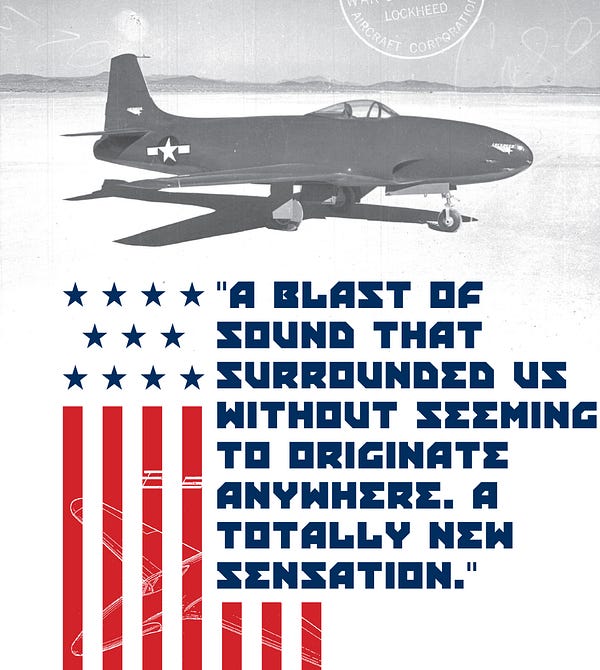
“A blast of sound that surrounded us without seeming to originate anywhere,” Johnson called it. “A totally new sensation.”
After
an hour of aerial gymnastics, Burcham heads back for a landing — and
he’s coming in hot. The pilot tears back the bubble canopy almost before
he finishes taxiing, jumps to the ground and throws down his helmet.
“Jee-sus Chee-rist, what a plane!” he shouts.
When
properly flown, the Me-262’s superior speed enabled penetration of
Allied airspace, and proved difficult to counter-attack. In direct
combat, Nazi pilots claimed five or more Allied kills for every Me-262
they lost. And through to the end of WWII, the Me-262 served in a
variety of roles — including light bomber, reconnaissance aircraft and
experimental night fighter.
THE IRONIES AND THE AFTERMATH
Air
Force officers had delighted in Burcham’s spirited show — and the
Shooting Star’s record-breaking 500 mph-plus speed. They wanted many
more jets, and quickly — and Johnson and Skunk Works were ready, willing
and able. But delivery would not come without cost.
“Shooting
Star” was a misnomer. Lockheed had boasted that its plane, unlike its
nemesis Nazi jet fighters, left no telltale comet-like exhaust trail by
day or by night. The Army had wanted proof, so Lockheed pilot Ernie
Claypool flew one night into a darkened sky and never returned. Flying
so clean and devoid of a trailing path, an Army bomber hit it head-on.
All occupants of both planes died instantly — and the point was
tragically made.
Later,
the great Milo Burcham also would die in a crash shortly after takeoff
due to failure of the fuel system. An emergency auxiliary system was
added as a result, but Major Richard Bong also was killed in a crash
when he failed to turn the system on following an engine failure.
Meanwhile,
the Me-262s — which had struck such fear into America’s heart — were
flying in increasing numbers. But the Allies were effectively countering
by attacking the German aircraft while they were still in their
hangars, or while taking off and landing. The Allies were beginning,
finally, to win the ground war.
In
the end — though the Nazis experienced more technical and production
difficulties than had originally been forecast — the Allies were lucky
that the German jets were not unleashed sooner, or they might have had
more than just a negligible impact.
Though
World War II ended before the Shooting Star could prove itself in
Europe, Lockheed still would build and deliver nearly 9,000 more of
them. And the first U.S. jet fighter ultimately would show its mettle in
the Korean War, winning the world’s first all-jet dogfight by shooting
down a Soviet MiG-15 in the skies above North Korea.
Lockheed
allowed Johnson to continue to run his relatively tiny research and
development operation as long as he kept it on a shoestring and it
didn’t distract from his principal duties. Overhead was kept low, and
financial risks to the company stayed small — which was fortunate, since
the first two development projects following the Shooting Star were
absolute clunkers.
But
Johnson — and Skunk Works — more than survived. By the time Johnson
retired in 1975, he was responsible for the design of more than 40
wartime and Cold War-era aircraft. And the Lockheed Martin Skunk Works
thrives to this day.
Special
thanks to Steve Justice, Heather Kelso, and Michigan Engineering
alumnus Benjamin Marchionna (BSE AeroE ’11) of Lockheed Martin for
making available to The Michigan Engineer materials that had never
before been released to the public; to Brook Engebretson of the
Huntington Library, where many of Kelly Johnson’s personal papers are
now held; and to Johnson’s stepson, John Horrigan, for his availability
and cooperation.
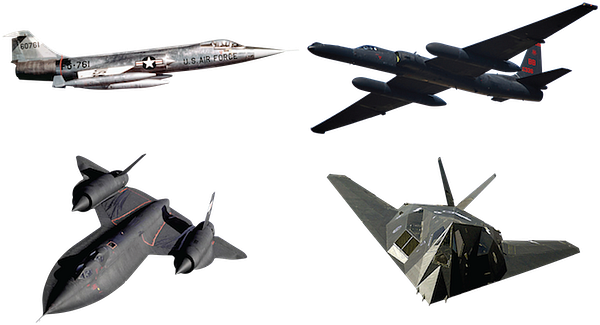
THEN AND NOW
During
his 42-year career, Johnson contributed to the design and construction
of more than 40 aircraft — including the path-breaking F-104
Starfighter, U-2 reconnaissance, SR-71 Blackbird, and F-117 Stealth
Fighter.
Though
the urgency for the Shooting Star might have been exaggerated, the Nazi
threat, coupled with Johnson’s peculiar characteristics — what current
Lockheed Martin Skunk Works Vice President Al Romig referred to at the
2014 Michigan Aerospace Centennial weekend as the confluence of “an
existential threat and a magical man” — was perhaps the only way such a
unique operation might ever have been formed in the first place.
Johnson
soon would organize his operational directives into “The 14 Practices
and Rules,” and skunk works-style tactics have become the standard by
which small, unconventional and autonomous groups might best achieve
achieve rapid, innovative and extraordinary results on advanced or
secret projects.
Why does the US spend more on its military than the next largest
several countries combined? One reason is that the military budget has
far less to do with protecting the United States than it does to further
enriching well-connected military contractors. Politicians are under
pressure to push weapons systems, that in turn produce “jobs” for their
districts. Remember, the disastrous F-35 fighter is built in 45 states
and several foreign countries. This doesn’t happen by accident.
As former Pentagon analyst and keen observer Chuck Spinney points out,
when it comes to the military budget, it’s all about enormously
expensive, high-tech weapons systems that don’t usually work. Little
things like readiness and force strength take a back-seat. High-tech
pays off well, with shiny things and bells and whistles impressing those
who sign off on big contracts. Actually giving troops useful tools to
win wars is much less exciting (and profitable).
Well “Spinney’s rule” has struck again. The USS Gerald R.
Ford, supposed to be the Pentagon’s largest and most advanced aircraft
carrier, is two years late for delivery, $2.9 billion over budget, and
is “not fit for combat.”
It is the most expensive warship ever built, coming in at $12.9 billion
(so far). But it can’t launch and recover aircraft, can’t mount a
defense, and can’t transport bombs around the ship. In other words, the
core functions of an aircraft carrier cannot be met by this particular,
gold-plated monstrosity.
The Pentagon is hoping that it will be fixed and delivered before
this November, but it is probably not wise to hold one’s breath.
Beltway think tanks drive policy toward engaging in more foreign conflicts and in turn they are lavishly funded
by the military contractors. Those who object to the massive spending
are called “soft on defense.” But spending thirteen billion dollars on a
ship that does not work undermines US national security far more than
all the antiwar activists put together. The money runs out and we are
left holding the bag with a totally useless gold-plated military and the
rest of the world angry and seeking revenge over the chaos sown by
decades of US interventionism.
In the morning on Jul. 16, when it was already enough clear that the military coup in Turkey had failed, at least one Turkish Air Force F-16 was circling to the west of Ankara.
We don’t know whether the TuAF F-16C Block 50 was flown by a loyalist
or a “rebel” pilot supporting the takeover because, since the beginning
of the revolt, reports have been contradictory as to whether the Air
Force supported the coup or remained loyal to Erdogan, that had landed
at Istanbul Ataturk international airport overnight.