Friday, April 22, 2016

Airbus to cut output of slow-selling A380 superjumbo


 European planemaker Airbus plans to cut production of its A380 superjumbo from 2017 as it struggles to revive sales of the world's largest passenger jet, two industry sources said.


Airbus to cut output of slow-selling A380 superjumbo


European planemaker Airbus plans to cut production of its A380 superjumbo from 2017 as it struggles to revive sales of the world's largest passenger jet, two industry sources said.
It has told its suppliers to slow production to support an assembly rate of 1.7 aircraft per month from next year, compared with production of just over two a month now, the sources said.
The exact month in which the slowdown would be felt in the Toulouse assembly plant was not immediately clear.
Airbus declined to comment on talks with suppliers.
"We can't comment on any discussions which may or may not have happened," a spokesman said.
The company does not publish production figures for its biggest model, but only targets deliveries.
Sales of large four-engine airliners like the 544-seat A380 have been hit by improvements in the range and efficiency of smaller two-engined models, which can be easier to fill.
Airbus, which has delivered 143 A380s since it began service in 2007, says the double-decker is becoming more attractive due to lower oil prices and also helps to solve airport congestion.
But because of long lead times the sources said Airbus had been forced to ask suppliers to slow the flow of parts.
Depending on the exact timing of the change, any slowdown could test the company's ability to continue to break even on the jet, after stemming losses for the first time last year.
Last year it delivered 27 A380s and has said it expects to continue to break even based on similar deliveries in 2016.
It meanwhile continues to cut costs in an effort to lower the breakeven point to as low as 20 aircraft a year.
Based on a full year, which Airbus counts as 11.5 months, the new production rate would yield 19.6 superjumbos a year.
In February Airbus Group Chief Executive Tom Enders said it had between 20 and 30 A380s on its delivery list for 2017.
RBC Capital Markets analyst Rob Stallard said he estimates Airbus will deliver 24 A380s next year, with its profit margin on the jet staying at zero, or exactly breakeven.
ORDER UNCERTAINTY
Production and deliveries do not always match because of extra customization work needed for new airline versions.
At the end of March Airbus had 135 aircraft on its books that have been sold and are waiting to be produced, mainly for leading customer Emirates which recently topped up its order.
But after deducting aircraft that are unlikely to be delivered, analysts say the order situation is weaker.
Air France has said it plans to cancel two A380s listed on the Airbus order book. Another 10 listed anonymously are believed to have been canceled by Hong Kong Airlines and 20 are allocated to leasing firm Amedeo, which are seen as unlikely to enter production until the lesser places them with airlines.
Analysts also say Qantas and Virgin Atlantic are unlikely to take a combined total of 12 of the jets.
The project received a boost earlier this year when Iran announced a preliminary order for 12 superjumbos as it emerges from sanctions, but doubts remain over how quickly the order can be finalised as Iran faces continued financial restrictions.
Airbus says it is working on several sales campaigns.

 

Friday, April 15, 2016

Boeing Vs. Bombardier: Delta?


Boeing Vs. Bombardier: What Do They Have To Offer Delta?


 http://seekingalpha.com/article/3965460-boeing-vs-bombardier-offer-delta


Boeing in the underdog in a battle that already seems to be won by Bombardier.
C Series optimized for the 100-150 seat market.
Clean sheet design gives Bombardier an edge over the 737.
Boeing (NYSE:BA) and Bombardier (OTCQX:BDRAF) are in a battle to win the McDonnell Douglas MD-88 replacement order from Delta Air Lines (NYSE:DAL). Although Boeing is the world's biggest jet maker, the company seems to be the underdog in this battle.
Delta currently operates 116 MD-88s, so the replacement for this fleet type will be a multi-billion order and a big win for any jet maker. In this article I will have a look at what both jet makers actually have to offer.
A look at the candidates
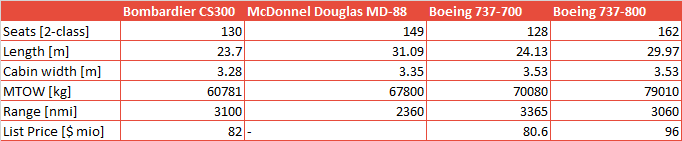
Table 1: Characteristics for various aircraft
What can be seen when comparing each of the aircraft with the aircraft that they have to replace is that they differ quite a bit, but the Boeing 737-700 seems to be superior in range. However, it can be questioned how useful that superior range is. The MD-88 has the shortest range of all aircraft and does the job for Delta Air Lines, so an improved range does not seem to be a requirement.
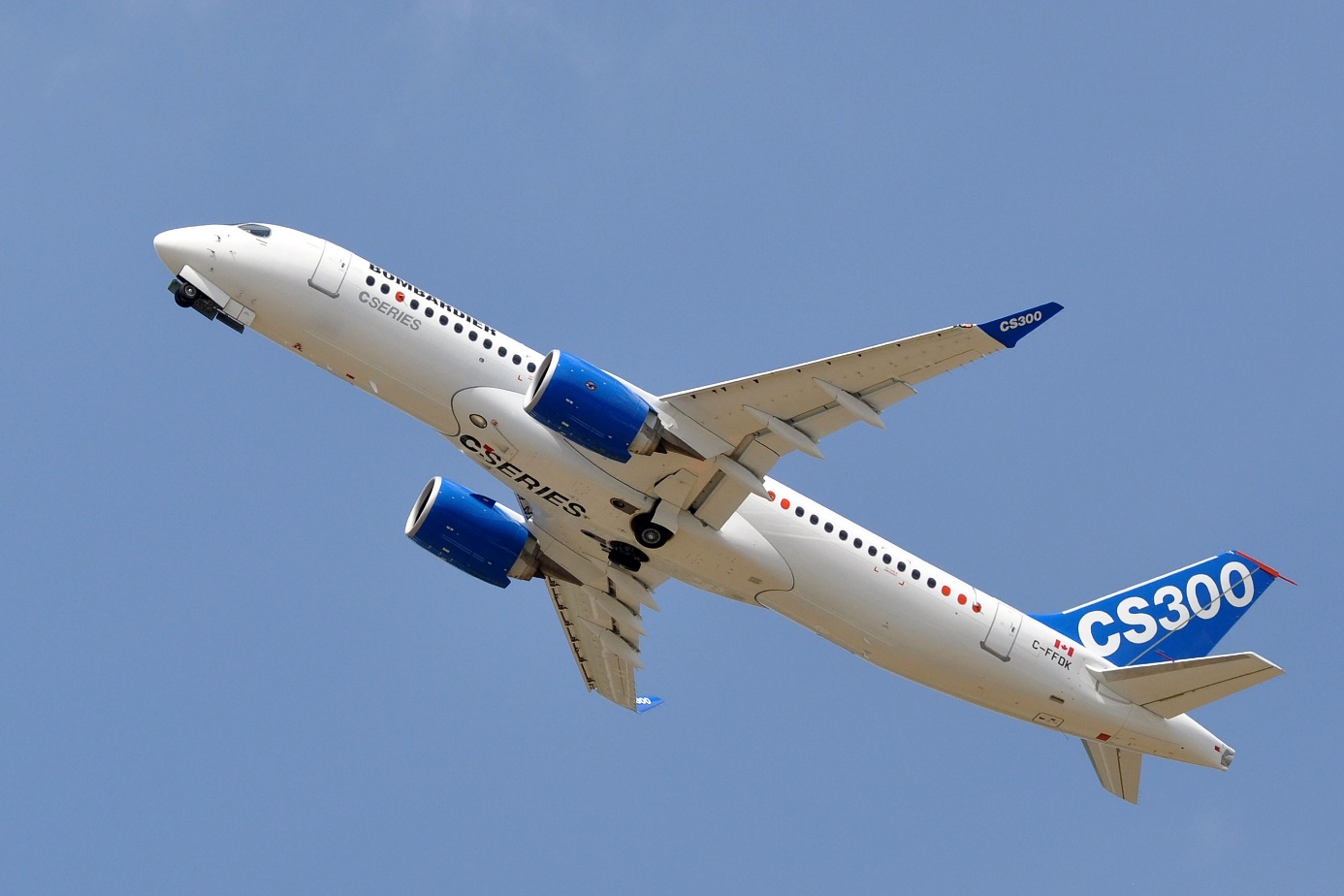
Comparing the seat figures the Bombardier CS300 has the advantage. Since it is known what aircraft is being replaced and the routes the aircraft will be utilized on, Delta Air Lines already has an idea on how many seats that aircraft should have. In this case, it is about 150 seats. The Boeing 737-700 can transport up to 149 to in dense configuration. So the Boeing 737-700 is too small, while the Boeing 737-800 with roughly 160 seats is too big. The CS300, with an extra pair of emergency doors, can transport up to 160 passengers.

Risks seen with Lockheed's F-35 fighter logistics system


Risks seen with Lockheed's F-35 fighter logistics

system


 http://www.reuters.com/article/us-lockheed-fighter-idUSKCN0XB2IA


A failure in the computer-based logistics system that serves as the "brains" of Lockheed Martin Corp's (LMT.N) F-35 fighter jet could potentially ground the fleet because it lacks a back-up for processing data, according to a congressional report.
The Government Accountability Office, the research arm of Congress, on Thursday released two reports on the $379 billion F-35 program, including one on the jet's $16.7 billion Autonomic Logistics Information System, or ALIS.
The second report, on the overall health of the Pentagon's biggest weapons program, said acquisition costs had decreased since 2014 and manufacturing efficiency was improving, but the program still faces difficult software testing and big affordability challenges in coming years.
ALIS supports everything from the plane's operations, pilot scheduling, mission planning and supply chain management to maintenance, making it one of the three major components of the jet, along with the airframe and engine.
The Pentagon's F-35 program manager, Air Force Lieutenant General Chris Bogdan, has repeatedly cited concerns about ALIS, which is so large it could be a separate arms program.
However, earlier this year, Bogdan told reporters that the F-35 jets could operate for a month or more without being connected to the ALIS system.
The GAO report recommended the Pentagon develop a holistic plan to address myriad issues with ALIS to ensure that the most pressing problems are resolved before the start of full production, instead of dealing with issues on a piecemeal basis.
It also cited a Pentagon-commissioned study from 2013 that found any delays or problems with ALIS could drive the cost of the overall F-35 program up by $20 billion to $100 billion.
On Thursday, Bogdan said the F-35 program office had taken steps earlier this year to map out strategic priorities for ALIS and meet the needs of the program's increasing global footprint. He said the plan would be completed this summer, in time to help shape the fiscal 2018 budget request.
The program office was planned to complete an assessment by the end of the year so it could develop a comprehensive training plan for the ALIS system.
GAO said one of the biggest concerns raised by 120 F-35 pilots, maintenance staff, contractors and program officials interviewed for the report was the lack of a redundant system for processing ALIS data.
Reliance on a single point of entry for all ALIS data and a single main ALIS operating unit in Fort Worth, Texas, means a weather-related loss of electricity or other failure could affect fleet operations or even ground it, GAO said.
GAO said Pentagon officials told investigators they recognized the risk and were in the early stages of trying to buy up to two more ALIS operating units for back-up, though no funds had been allocated for that purpose at this point.
The report also raised concerns about lack of testing of a new, more deployable version of ALIS, the inability of the system to communicate with systems used to support older fighter jets and continuing information security concerns.